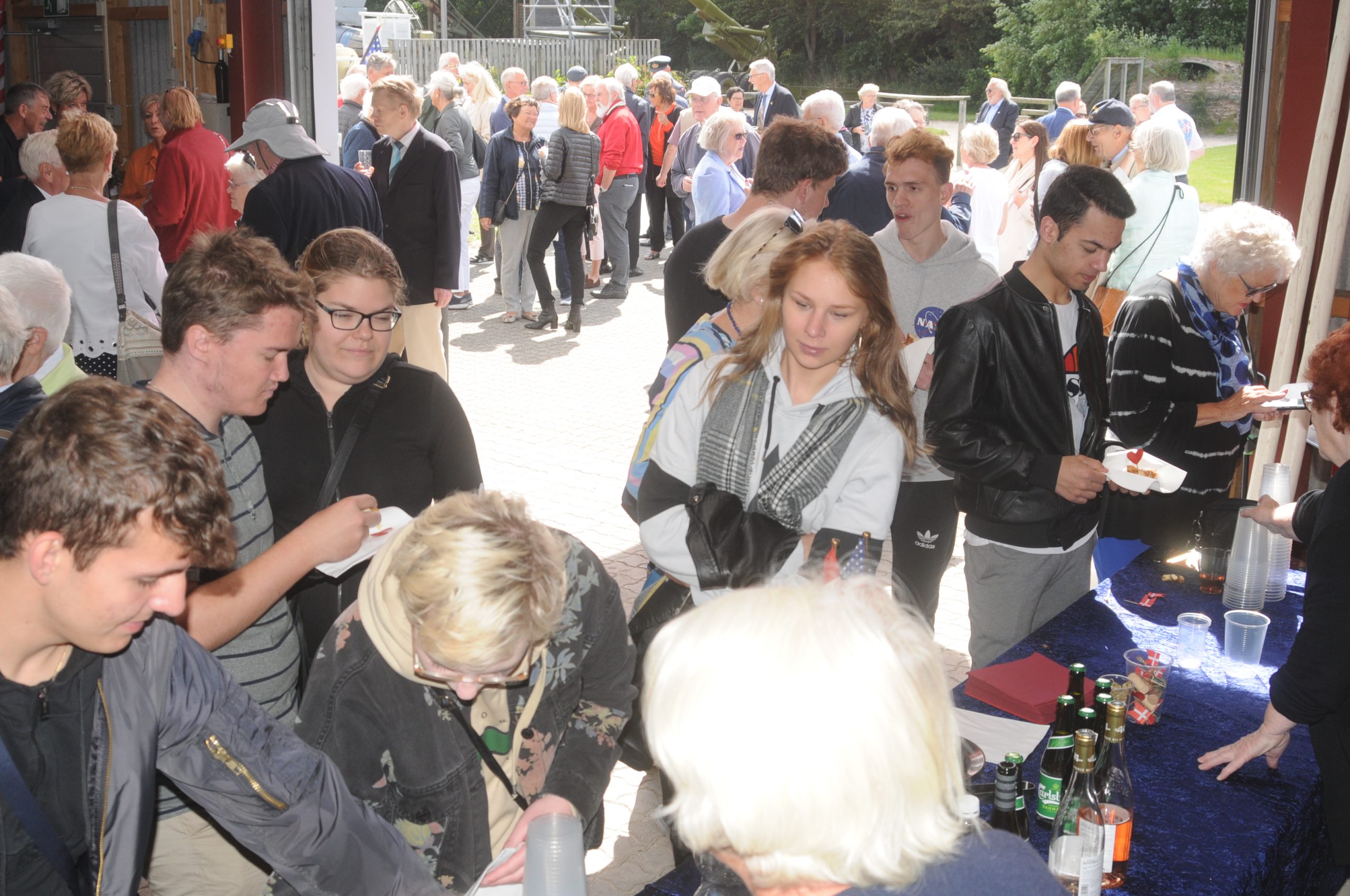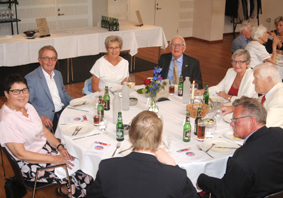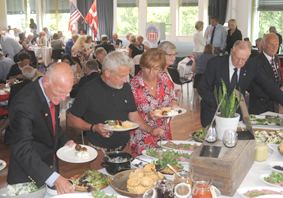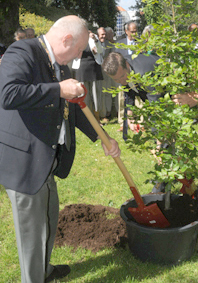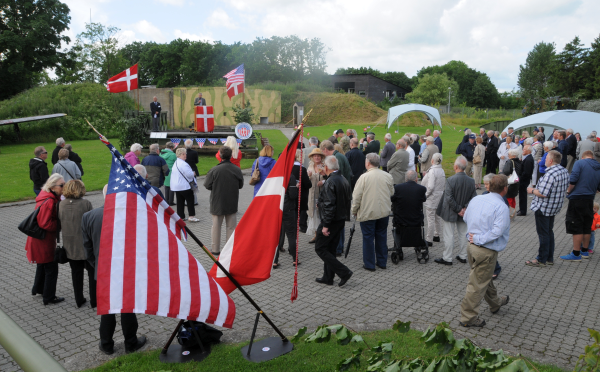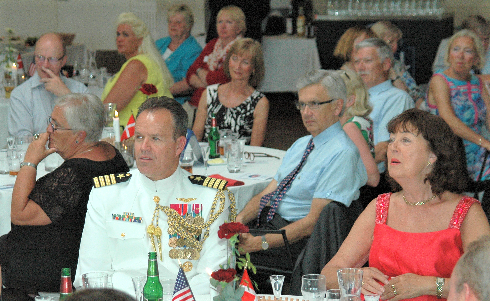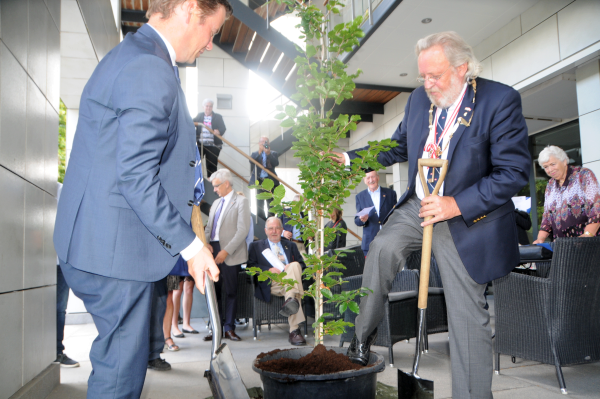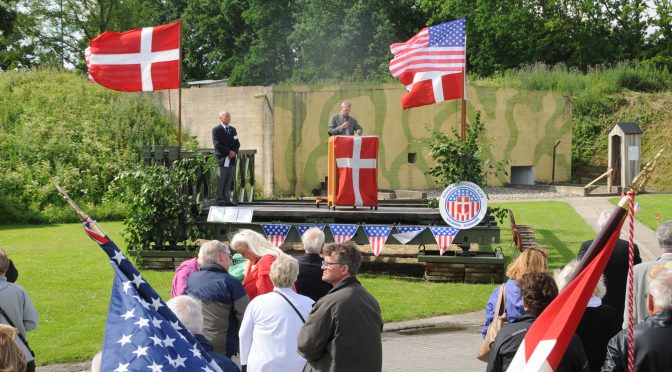
Det er altid spændende hver 3. juli til den årlige Borgmesterfrokost at få afsløret Borgmesteren for en Dag, hvilket der er tradition for.
Aalborgs Borgmester og Præsidenten for DAK, Niels Guldbjerg, har altid æren af at præsentere den udvalgte Borgmester for en Dag.
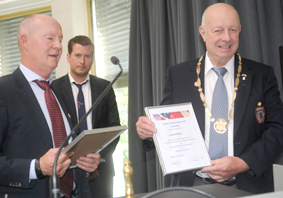
I år måtte Aalborgs borgmester, Lasse Frimand Jensen, overdrage borgmesterkæden til Præsidenten for Chicago Midwest Rebild Chapter, Lars Rasmussen, som med stolthed bar den hele dagen.
Lars Rasmussen og hans kone, Bente, har været særdeles aktive i det dansk-amerikanske samfund i USA, hvor Lars har været Præsident for Dania Society of Chicago siden 2015, Præsident for Chicago Midwest Rebild Chapter siden 2017, og aktivt medlem af Danish American Athletic, The Danish Home of Chicago, Scandinavian Park, The Danish Sisterhood of America m.m.
Lars Rasmussen står for at arrangere den årlige ”Annual Scandinavian Park Painting Day” hver maj måned ved Vasa Park i South Elgin, Illinois. Her bidrager ca. 35 personer med at male og lave havearbejde en hel dag for at vedligeholde den smukke park, Vasa Park, i South Elgin.
Lars og Bente deltager som regel på Rebild Årsmøderne, som afholdes forskellige steder i USA, og de er altid villige til at give en hånd med i forberedelserne. I 2024 modtog de Rebilds Top Karens Pris.
Lars er ingeniør og en dygtig investeringsrådgiver med gode lederegenskaber, og det er der ikke noget at sige til, da han er en pålidelig, venlig, omsorgsfuld og gemytlig person. Lars engagerer sig helhjertet i det dansk-amerikanske samfund. Han er kendt for at tage mange billeder af de forskellige events i Rebild regi og dele dem med sin familie og venner på Facebook.
Lars og Bente bor i Libertyville, Illinois. De fejrer Guldbryllup i 2027. Deres to sønner og svigerdøtre og barnebarn bor også i USA.
DAK, Rebildselskabet og Aalborg Kommune ønsker Lars Rasmussen tillykke med titlen Borgmester for en Dag med tak for alt hvad han gør for det dansk-amerikanske samfund, hvilket han gør med et smil, med medfølelse, og med beslutsomhed, sammen med Bente.
Traditionen tro, var der ved Borgmesterfrokosten en tale for Amerika. I år blev det Deborah Lorenzen, CEO for Lorenzen Advisors, bosiddende i Aalborg, der leverede en fremragende tale om optimisme; et godt valgt emne for den tid, vi nu lever i.
Deborah Lorenzen er amerikaner og bor i Danmark med sin danske mand og børn, og hun beskriver sig selv på LinkedIn sådan:
“Experienced international executive and board chair with a strong track record in business transformation, digitalization, and cultural renewal. Over 30 years in leadership roles at State Street Global Advisors and BNY Mellon, across the U.S. and Europe. Based in Denmark, I focus on helping mid-sized companies strengthen governance, scale operations, and leverage new technology to drive growth and resilience. My board experience spans financial services, technology integration, and organizational culture — areas critical for companies navigating growth, internationalization, and professionalization. I bring a balanced, Nordic, and international approach to leadership — transparent, values-driven, and focused on long-term impact.”
Læs gerne om Deborahs danske rødder og interessante synspunkter i hendes tale nedenfor:
“””””
Thank you Quynh, Niels, and the Danish American Club, for the opportunity to speak for America today.
I am the wretched refuse of your teeming shores. I’m back. Today I’d like to talk about The American Dream, this belief that anyone, regardless of their background or social class, who your father was or where you came from, can achieve success through hard work, determination, and initiative. Remember that, anyone can, but not everyone will.
It is said that a pessimist is the one who can see all the problems. And an optimist sees all of the problems, but knows it can get worse. In that way, my grandfather was an optimist. He was the American Dream, that for him, things could get better.
He was born to a Danish family in Hjerpsted, in 1896. Being born in Germany he was conscripted with his brother in the first war and sent to France. He came home 4 years later, alone.
Hjerpsted is a hardscrabble place where the small trees grow sideways from the wind off the north sea, and dinner for him was fishhead soup because the fish themselves could be sold for money. When he voted to move the border south of Hjerpsted in 1920 he got Danish citizenship and a passport, but no work, so he used his passport to emigrate to California. He was chasing the American dream.
He arrived with nothing except a contact name to a fake cousin, and a certification that he was a smith, which he was not, but he had heard that skill could get him in the door. It worked. By the time the great depression came a few years later he had bought his first piece of land and a few cows to walk on it, a feat he could not have accomplished in the old country, as he called it. He had found and married Ingeborg and had two sons.
He was optimistic in the chaos of the great depression. He knew it could be worse. America is a land of optimists.
In the early 1930’s during the height of the depression, my grandfather came into the kitchen in the middle of the day, called his sons, and sliced off the thickest slices of bread the boys could remember seeing. Then he slathered them with pork fat and sprinkled salt on top. He packed them up and told the boys to follow him. At the end of the driveway was an old jalopy. In it was a family, fresh from Oklahoma. In the back seat the children were starving. Not hungry, starving, and the bread was for them. My father never forgot those children. That was part of his America. When things went bad for him, throughout his life, he knew it could be worse. But things kept getting better.
Since that time America has seen tremendous growth, the Marshall plan, Mccarthyism, the rise of Hollywood, Watergate, 1970s hyperinflation, 1980s hair, Mr. Gorbachev tear down this wall, global dominance of geopolitical softpower. Meanwhile my father sent four children to college, a feat he never accomplished himself. He believed in the American Dream.
Today, on the eve of our 250th anniversary for my somewhat confusing, chaotic, optimistic, innovative, messed up, beautiful, strange nation, let me try to articulate how I, we, can stand at this particular inflection point and still be optimistic. How we can still believe in the American Dream.
With a career in financial services I spend a lot of time looking at economic data, market impacts, and strategic risks. Lately it is hard not to run around saying “the sky is falling, the sky is falling”! Is the American Dream in trouble?
If we look at the fundamentals, we can clearly see cracks. Let’s take 3 – Inflation, Interest Rates & the US equity markets.
● Inflation in the US at 4.2% at end of May
○ While the price of eggs specifically has fallen, volatile global energy prices, sticky housing markets and supply-chain disruptions are causing spikes in commodity prices. The pain points of gas, food, electricity and medical costs are hitting average Americans especially especially hard.
○ JP Morgan notes the high risk of negative growth – why don’t they say losses? – is raising unemployment rates. The ECB has already taken action to counter inflationary pressures, while the Fed has yet to move. Opening the strait of Hormuz will help, when it happens, but there is a lotyet to come before the energy markets stabilize.
● Interest rates: The fed funds rate is at 3.5% and prime at 6.75% which puts the 30 year fixed mortgage at around 6.5%, more than double the lows during the pandemic. – the era of cheap money is over.
○ Commercial Real Estate. Distressed office building sales are accelerating in 2026 as post-pandemic leases finally expire. In Chicago , for example, a vacant landmark from the late 1800s recently sold for $4 million, a 90% discount off its $68 million sale price ten years ago. There are lots more like that one.
○ In family housing: Higher interest rates have also stagnated the market, since people sitting with a 30 year fixed mortgage at 3% are loath to give that up for a new home at double the rate. The Census Bureau shows both single family housing starts, and completions, are down YTD, and multi-family homes are forecast to decline around 5%. This, when the Federal Reserve noted in May a structural shortage of 1-4 million homes. We have a shortfall but nobody is building.
● Last, lets turn to the Equity Market:
○ Index funds own 20% of the available shares in the US stock market, and the index funds themselves are ultimately owned by consumers through pension funds. While it takes a brilliant mind to get a fund to track the market exactly, the funds themselves don’t think before they buy – if it is in the market it is in the index. Indexes are considered safer since they are a buy on the broad market, rather than an individual stock.
That safety is being challenged right now. For example, Nasdaq usually waits 12 months before including newly issued companies in the index. For the recent SpaceX IPO, the year has been waived down to 15 days. That means Nasdaq index funds will begin buying SpaceX shares on Monday. Due to lockups, only about 4% of the shares are publicly available now, so while the indexes will be forced to buy in on Monday, there isn’t much stock around, causing volatility and likely driving up the price due to demand, rather than any valuation. The Chief Economist at Apollo, Torsten Slok , another Dane, noted recently that “Prices are increasingly set by mechanical flows rather than by anyone judging what companies are actually worth.”
My personal belief is that this kind of market shenanigans, where powerful wall street players – those who control the Nasdaq – bend the rules to favor holders of locked up SpaceX stock, e.g., powerful wall street players, will make a nice book for Michael Lewis in a few years time.
The sky is falling! The sky is falling!*
What does all this mean for the American Dream? Can things get better? Well, egg prices are down! The Knicks won the series!
No, seriously. That vacant landmark which sold at a 90% discount? Bought on them cheap, it is now being re-envisioned as a vertical urban farm, alongside a health research center, a rooftop garden, and a portion of the building into student and senior housing. The new owners are optimistic they can build a whole new hub of innovation.
That Trillion dollar IPO which is roiling the financial markets, was issued by a South African immigrant who became a naturalized citizen first in 2002. He is optimistic about making it to Mars in the 2030’s. In fact, immigrants cofounded nearly 60% of America’s unicorns – billion-dollar startups. For some people, things are definitely getting better!
The American Dream, this belief that anyone can achieve success through hard work, says that anyone can. It doesn’t say that everyone will. This innovation, renovation, this constant chaos and turnover is part of our DNA. It also has sharp edges and often leaves a mess. And we only like to talk about the winners.
At the same time my grandmother Ingeborg’s family was emigrating from Southern Jutland, Jacob Riis, another Dane, was taking pictures of the slums of New York, showing us all how the other half lives. Today there are homeless encampments bordering Silicon Valley as the haves and have nots pretend not to see each other.
The question we must continue to ask ourselves is not if the American Dream is still alive, but if we indeed want it to be, or if so, to what extent. Maybe it is time for a new dream, one with universal housing and healthcare, and state supported higher education. Traits that might lead a country to be named both the happiest country in the world, and the best country for women. Wait, that is the other speech…
Perhaps we can be optimistic enough to believe that when the current market inevitably falls off the cliff, the need will be so great and so visible that we come together as a nation to form the next New Deal. And that the new New Deal will yet again propel America, and Americans, forward into even greater success over the next 250 years. Perhaps.
In the meantime, I’ll stay optimistic.
Please join me in raising a glass to my flag. To my country. With all our hopes and dreams, our opportunities and imperfections. My confusing, chaotic, optimistic, innovative, messed up, beautiful, strange nation, the United States of America.
“”””””
*The expression “The sky is falling” originates from a European folktale, Chicken Little. In the story, someone is hit on the head by a falling acorn, and believes the sky is falling and runs around warning, “The sky is falling!”. The idiom is generally used as fearmongering.
IIndkaldelse til ordinær generalforsamling i Dansk Amerikansk Klub, Aalborg
Ordinær generalforsamling afholdes torsdag den 12. marts 2026, kl 20.00 på
GASSEN, Gasværksvej 48, 9000 Aalborg
Dagsorden ifølge vedtægterne:
Valg af dirigent
Præsidenten aflægger beretning for det forløbne år
Kassereren fremlægger det reviderede regnskab til godkendelse
Behandling af indkomne forslag
Valg af 3 bestyrelsesmedlemmer for 2 år. På valg er:
Flemming Pedersen
Jane Schultz
Ingrid Thomas
Valg af 2 revisorer for 1 år. På valg er:
Eva Vestergaard
Erling Møller
Valg af 2 suppleanter til bestyrelsen for 1 år. På valg er:
Karina Stevenson
Helle Agerbak
Eventuelt
Forslag, der ønskes behandlet på den ordinære generalforsamling, skal skriftligt være bestyrelsen i hænde på præsidentens adresse senest den 27. februar 2026. Send forslag til:
Dansk Amerikansk Klub v/Præsidenten Niels V Guldbjerg Tidselbakken 16 9310 Vodskov
Inden generalforsamlingen, kl. 19.00, vil der være spisning, hvor der serveres smørrebrød, med øl, vin eller vand, + kaffe & småkager til en pris af kr. 150,-/deltager
Tilmelding til spisning nødvendig. Tilmeld dig til senest TORSDAG 5. MARTS kl 20:00:
ELLER på MobilePay 41127 (Angiv venligst “generalforsamling” som kommentar)
Hvis du endnu ikke har betalt kontingent, kan dette nås endnu, hvorved du bliver stemmeberettiget på generalforsamlingen. Det kan i nødstilfælde også klares ved indgangen hvis man ikke har mulighed for at betale via Nemtilmeld, MobilPay, netbank eller bank.
Dagsorden ifølge vedtægterne:
Valg af dirigent
Præsidenten aflægger beretning for det forløbne år
Kassereren fremlægger det reviderede regnskab til godkendelse
Behandling af indkomne forslag
Valg af præsident – (Villig til genvalg)
Valg af 3 bestyrelsesmedlemmer for 2 år. På valg er:
Jette Severinsen (genopstiller ikke)
Marisol Jensen (genopstiller ikke)
Jørgen Østergaard (villig til genvalg)
Valg af 2 revisorer for 1 år. På valg er:
Eva Vestergaard
Erling Møller
Valg af 2 suppleanter til bestyrelsen for 1 år. På valg er:
Henrik Genefke
Vakant
Eventuelt
Forslag, der ønskes behandlet på den ordinære generalforsamling, skal skriftligt være bestyrelsen i hænde på præsidentens adresse senest den 27. februar 2025. Send forslag til:
Dansk Amerikansk Klub v/Præsidenten Niels V Guldbjerg Tidselbakken 16 9310 Vodskov
Inden generalforsamlingen, kl. 19.00, vil der være spisning, hvor der serveres smørrebrød, med øl, vin eller vand, + kaffe & småkager til en pris af kr. 150,-/deltager
Tilmelding til spisning nødvendig. Tilmeld dig til senest MANDAG 3. MARTS kl 20:00:
ELLER på MobilePay 41127 (Angiv venligst “generalforsamling” som kommentar)
Hvis du endnu ikke har betalt kontingent, kan dette nås endnu, hvorved du bliver stemmeberettiget på generalforsamlingen. Det kan i nødstilfælde også klares ved indgangen hvis man ikke har mulighed for at betale via Nemtilmeld, MobilPay, netbank eller bank.
The event is very informal but there will be a couple of talks from Americans that have lived in the area for several years. The purpose of the event is to create a setting and meeting place where Americans living in Denmark can meet, share ideas and experiences and create a network with other Americans.
I Dansk Amerikansk Klub har vi således 25 pladser så tilmelding er efter først til mølle-princippet. Grundet den begrænsede adgang tillader vi ingen gæster denne gang.
OBS: Ikke egnet for dårligt gående (2 kilometer i rask tempo)
Ingen tasker må medbringes på rundvisningen (aflåste skabe tilbydes)
Ikke mulighed for toiletbesøg under rundvisningen
Der er køligt i bunkeren, så varm trøje eller jakke anbefales
Til Borgmesterfrokosten i år, var der, som altid, nogle få taler. Vi der deltog i arrangementet er enige om, at der specielt var en tale der trådte frem som bemærkelsesværdig, uden dermed at sige, at de andre taler ikke var gode. Men denne tale synes vi, at i alle skal have fornøjelsen af at læse.
Det var “Talen for Amerika” med Morten Wendelbo. Morten har været bosat i USA i en del år og har blandt andet en Bachelors Degree i Political Science, en Master Degree i Public Policy og er Research Fellow ved The American University. Han har optrådt som politisk ekspert på både DR og TV2.
Og så var det for øvrigt Morten der sidste efterår satte os grundig ind i det Amerikansk valgsystem ved et arrangement på “Gassen”.
Good afternoon, everyone. Or, as I much prefer: Good afternoon, y’all.
I grew up not far from here, in a small village called Birkelse, near Aabybro. My mom was a primary school teacher there for nearly 40 years, and my dad worked at Nordkraft—back when it was a power plant, and not yet one of the best cultural institutions in Denmark. My parents still live in the house I grew up in. I went to school just up the road at Skipper Clement Skolen, and then on to Nørresundby Gymnasium. In other words, I’m a local kid. As one Dane I recently met in Copenhagen declared after hearing me speak maybe four words in Danish: “Du er da vist nok Nordjyde!” And yes, that I am. Proudly. Through some unexpected twists and turns in my life, I am also American. In my first year at Nørresundby Gymnasium, I won a scholarship to a school in Costa Rica. That opportunity led to me being recruited by many colleges in the United States and so at 19, I moved to the US. I spent 14 years in the U.S.—continuing on to graduate school and then to work in Washington, D.C., before returning to Denmark two years ago.
I am honored that Dansk-Amerikansk Klub has asked me to give the speech for America today. The club, with its 100+ year history, is the embodiment of something most of us know to be true deep in our bones: Denmark and the United States are better together. When we collaborate, we are better in business. We are better in defense. Our communities are forever improved when we share our science, our innovation, and our culture. This club was founded, in part, to foster this relationship, and I, for one, am grateful for the work that so many members have poured into the club in the 103 years since its founding.
I have gone back and forth on how to approach this speech—because what exactly does it mean to give a speech for America – particularly given recent events? The first half of my life, America was an incredible and romanticized IDEA. America was the gold standard in TV, movies, computer games, and magazines. When America was described, it was usually with awe and fascination. In America, everything is bigger, cooler, and more glamorous. America is a land of extremes. It’s skyscrapers and dirt roads. It’s fast-talking New York Bankers and farmers with a southern drawl. It’s lifted pickup trucks and electric scooters. It’s NASCAR on Sunday and televangelists for insomniacs. It’s Super Walmart, drive-thru everything, and pumpkin spice season starting in August. To me, America was the figurative promised land—a melting pot of immigrants that contribute world-class talent to create a multicultural kaleidoscope. And all of this was underpinned by the American Dream – that pull-yourself-up-by-your-bootstraps, sky-is-the-limit kind of freedom that is anyone’s for the taking if you’re just willing to put in the hard work. Like three hundred thousand Danes before me, I made my way to the United States—and I thought I had it “made in the shade.” I was ready to seize opportunity and chase the American Dream. And I did live the American Dream. From inside the proverbially gilded walls of one of America’s prestigious universities, I thrived. I developed my research skills, made invaluable connections, and studied abroad on two other continents. I had access to cutting edge treatments when I got cancer, and I had no fear of the future because I had what felt like unlimited access to opportunity.
It took me far too long to realize that the American Dream I was living was, in fact, denied to tens of millions of others who weren’t set up for success the way I was. Of course, wild success IS possible in the US. But for tens of millions of Americans, even modest comfort is unlikely, much less wild success. A fact we often forget to acknowledge when we’re touting the American Dream. Poverty in America is real, and determination and hard work alone isn’t lifting people out of it. Most Americans who live in poverty do so despite determination and hard work—far harder work than I ever put in. The late Barbara Ehrenreich once wrote something that helped me understand why the dream I was living was a nightmare for so many others. “The American Dream,” Barbara said, “only applies if you’re already halfway there.” That is, hard work only leads to success when you’re already financially stable, already have a good education, a social network that connects you to opportunities, a reliable income, healthcare, and access to credit—among many other things. What I have come to realize is that I got to live the American Dream because, when I arrived, I was already halfway there. Denmark, Aalborg, Jammerbugt, Skipper Clement Skolen, Nørresundby Gymnasium are all among the reasons I was already halfway there. Parents, teachers, family, and friends who didn’t have to worry about their own future or about making ends meet had time, patience, and the skills to help shape me into someone who was already halfway there when I arrived. I am not the one who put in the hard work to get me the first half of the way. My community did that work.
I’ll be honest—I took what Aalborg and Denmark gave me for granted. Because I could… and because it simply didn’t occur to me that it could be any other way.
So let me take this moment to say thank you to everyone here. Whether you’re a nurse, a teacher, a diplomat, a titan of industry, a volunteer football coach, the mayor, or something else entirely—the work you put into your community every day is a big part of why most Danes never have to worry about whether they’ll make it the first half way there.
Don’t worry, I haven’t forgotten that this is a speech for America. Or—if I may spin it just for today—a speech for Americans. Away from the grand IDEA of America, and toward the reality of its people. Because while many Americans cannot take for granted that they’ll get halfway there in time, tens of millions still do the quiet, relentless work to make sure their children can. They help children in their neighborhoods and in their communities get the first half of the way there. Parents, grandparents, neighbors sacrifice daily so that someone else might have a better shot. They work so hard to create the kind of community I came to take for granted here. They drive trucks through the night. They stock shelves while the rest of us sleep. They pick lettuce in 40-degree heat. They clean hotel rooms, care for the elderly, deliver takeout, and dozens of other jobs that are rarely noticed or appreciated. Some work three jobs just to keep the lights on because they believe—quietly and stubbornly—that their children and their community deserve a shot. That if they can carry the weight just a little longer, the next generation might stand a little taller.
America’s greatness shouldn’t be measured by the successful outliers, but by a community that works relentlessly to get everyone – their kids, their neighbors and sometimes people they’ll never meet – the first half of the way there. So, this speech is for the Americans who show up for each other. For those Americans who carry far more than their share. They don’t have to—but they still do. And that, more than anything else, makes me believe that despite the world we live in today, there is still a real chance that Americans—all Americans, no matter their race, ethnicity, language, sexual orientation, gender, or disability; no matter what state they’re born in or what tax bracket their parents belong to— that all Americans will one day get to trust that they’ll make it halfway there…in time to do their own part for the second half.